Showing posts with label annotations. Show all posts

Saturday, August 08, 2020

Disambiguating SciSpacy + UMLS entities using the Viterbi algorithm

The SciSpacy project from AllenAI provides a language model trained on biomedical text, which can be used for Named Entity Recognition (NER) of biomedical entities using the standard SpaCy API. Unlike the entities found using SpaCy's language models (at least the English one), where entities have types such as PER, GEO, ORG, etc., SciSpacy entities have the single type ENTITY. In order to further classify them, SciSpacy provides Entity Linking (NEL) functionality through its integration with various ontology providers, such as the Unified Medical Language System (UMLS), Medical Subject Headings (MeSH), RxNorm, Gene Ontology (GO), and Human Phenotype Ontology (HPO)


The NER and NEL processes are decoupled. The NER process finds candidate entity spans, and these spans are matched against the respective ontologies, which may result in the span matching zero or more ontology entries. All candidate span is then matched to all the matched entities. 

I tried annotating the COVID-19 Open Research Dataset (CORD-19) against UMLS using the SciSpacy integration described above, and I noticed significant ambiguity in the linking results. Specifically, annotating approximately 22 million sentences in the CORD-19 dataset results in 113 million candidate entity spans, which get linked to 166 million UMLS concepts, i.e., on average, each candidate span resolves to 1.5 UMLS concepts. However, the distribution is Zipfian, with approximately 46.87% entity spans resolving to a single concept, with a long tail of entity spans being linked to up to 67 UMLS concepts. 

In this post, I will describe a strategy to disambiguate the linked entities. Based on limited testing, this chooses the correct concept about 73% of the time. 

The strategy is based on the intuition that an ambiguously linked entity span is more likely to resolve to a concept that is closely related to concepts for the other non-ambiguously linked entity spans in the sentence. In other words, the best target label to choose for an ambiguous entity is the one that is semantically closest to the labels of other entities in the sentence. Or even more succintly, and with apologies to John Firth, an entity is known by the company it keeps. 

The NER and NEL processes provided by the SciSpacy library allows us to reduce a sentence to a collection of entity spans, each of which map to zero or more UMLS concepts. Each UMLS concept maps to one or more Semantic Types, which represent high level subject categories. So essentially, a sentence can be reduced to a graph of semantic type using the following steps. 

Consider the sentence below, the NER step identifies candidate spans that are indicated by highlights.
The fact that viral antigens could not be demonstrated with the used staining is not the result of antibodies present in the cat that already bound to these antigens and hinder binding of other antibodies.
The NEL step will attempt to match these spans against the UMLS ontology. Results for the matching are shown below. As noted earlier, each UMLS concept maps to one or more sematic types, and these are shown here as well.
   
Entity-ID Entity Span Concept-ID Concept Primary Name Semantic Type Code Semantic Type Name
1 staining C0487602 Staining method T059 Laboratory Procedure
2 antibodies C0003241 Antibodies T116 Amino Acid, Peptide, or Protein
T129 Immunologic Factor
3 cat C0007450 Felis catus T015 Mammal
C0008169 Chloramphenicol O-Acetyltransferase T116 Amino Acid, Peptide, or Protein
T126 Enzyme
C0325089 Family Felidae T015 Mammal
C1366498 Chloramphenicol Acetyl Transferase Gene T028 Gene or Genome
4 antigens C0003320 Antigens T129 Immunologic Factor
5 binding C1145667 Binding action T052 Activity
C1167622 Binding (Molecular Function) T044 Molecular Function
6 antibodies C0003241 Antibodies T116 Amino Acid, Peptide, or Protein
T129 Immunologic Factor

The sequence of entity spans, each mapped to one or more semantic type codes can be represented by a graph of semantic type nodes as shown below. Here, each vertical grouping corresponds to an entity position. The BOS node is a special node representing the beginning of the sequence. Based on our intuition above, entity disambiguation is now just a matter of finding the most likely path through the graph.
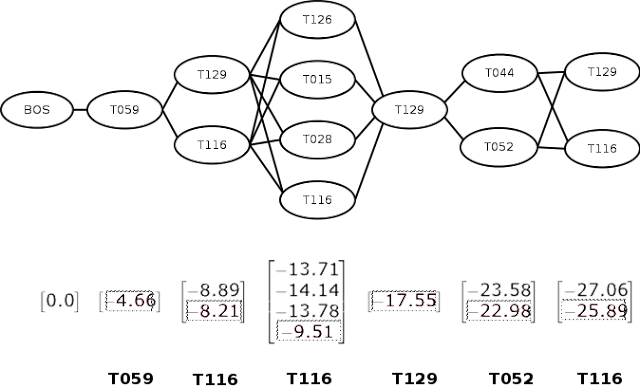


Of course, "most likely" implies that we need to know the probabilities for transitioning between semantic types. We can think of the graph as a Markov Chain, and consider the probability of each node in the graph as being determined only by its previous node. Fortunately, this information is already available as a result of the NER + NEL process for the entire CORD-19 dataset, where approximately half of the entity spans mapped unambiguously to a single UMLS concept. Most concepts map to a single semantic type, but in cases where they map to multiple, we consider them as separate records. We compute pairwise transition probabilities across semantic types for these unambiguously linked pairs across the CORD-19 dataset and create our transition matrix. In addition, we also create a matrix of emission probabilities that identify the probabilities of resolving to a concept given a semantic type. 

Using the transition probabilities, we can traverse each path in the graph from starting to ending position, computing the path probability as the product of transition probabilities (or for computational reasons, the sum of log-probabilities) of the edges. However, better methods exist, such as the Viterbi algorithm, which allows us to save on repeated computation of common edge sequences across multiple paths. This is what we used to compute the most likely path through our semantic type graph. 

The Viterbi algorithm consists of two phases -- forward and backward. In the forward phase, we move left to right, computing the log-probability of each transition at each step, as shown by the vectors below each position in the figure. When computing the transition from multiple nodes to a single node (such as the one from [T129, T116] to [T126], we compute for both paths and choose the maximum value. 

In the backward phase, we move from right to left, choosing the maximum probability node at each step. This is shown in the figure as boxed entries. We can then lookup the appropriate semantic type and return the most likely sequence of semantic types (shown in bold in the bottom of the figure). 

However, our objective is to return disambiguated concept linkages for entities. Given a disambiguated semantic type and multiple possibilities indicated by SciSpacy's linking process, we use the emission probabilities to choose the most likely concept to apply at the position. The result for our example is shown in the table below.

Entity-ID Entity Span Concept-ID Concept Primary Name Semantic Type Code Semantic Type Name Correct?
1 staining C0487602 Staining method T059 Laboratory Procedure N/A*
2 antibodies C0003241 Antibodies T116 Amino Acid, Peptide, or Protein Yes
3 cat C0008169 Chloramphenicol O-Acetyltransferase T116 Amino Acid, Peptide, or Protein No
4 antigens C0003320 Antigens T129 Immunologic Factor N/A*
5 binding C1145667 Binding action T052 Activity Yes
6 antibodies C0003241 Antibodies T116 Amino Acid, Peptide, or Protein Yes
(N/A: non-ambiguous mappings) 

I thought this might be an interesting technique to share, hence writing about it. In addition, in the spirit of reproducibility, I have also provided the following artifacts for your convenience.
  1. Code: This github gist contains code that illustrates NER + NEL on an input sentence using SciSpacy and its UMLS integration, and then applies my adaptation of the Viterbi method (as described in this post) to disambiguate ambiguous entity linkages.
  2. Data: I have also provided the transition and emission matrices, and their associated lookup tables, for convenience, as these can be time consuming to generate from scratch from the CORD-19 dataset.
As always, I appreciate your feedback. Please let me know if you find flaws with my approach, and/or you know of a better approach for entity disambiguation

Sunday, April 19, 2020

Inexact Matching Text against Dictionary using the Aho-Corasick Algorithm


In the past, I have written about matching text against dictionaries using David Smiley's SolrTextTagger project. SolrTextTagger uses Lucene's Finite State Transducer (FST) technology to implement a Finite State Machine (FSM) usable by the Aho-Corasick string matching algorithm. As indicated on its Wikipedia page, the Aho-Corasick algorithm has some nice performance properties that make it very attractive for text annotation, which is the use case I am interested in as well. To support the use case, I built the Solr Dictionary Annotator (SoDA) project, which wraps the SolrTextTagger service in a slightly more usable API and provides multiple levels of matching (exact, lowercase, stemmed, etc).

To set up a SolrTextTagger index, or the Aho-Corasick string matching algorithm in general, the basic idea is to populate the FSM with the dictionary entries. Internally, this will create a Trie structure connecting the words in the dictionary entries to each other. At runtime, you would stream text against this structure, and it will match phrases in the text that match the dictionary entries. The one major disadvantage of this approach is that it will only match phrases in the text that are in the same order as the equivalent phrase in the dictionary. For example, if my dictionary entry is "tuberculosis pulmonary", it will not match "pulmonary tuberculosis" in the text. Depending on your application, this may or may not be important. But I recently discovered a way to do it, thanks to the ideas presented in the paper Efficient Clinical Concept Extraction in Electronic Medical Records (Guo, Kakrania, Baldwin, and Syeda-Mahmood, IBM Research Almaden, 2017). Hat tip to my manager Ron Daniel for pointing me to the paper.

Specifically, the part that caught my eye was their example of being able to match the string "Chest CT" from the phrase "a subsequent CT scan of the chest", and their description of their approach in the paper. As you can see, there is not much detail in there, so I am not sure if my approach is identical to theirs or not, but it got me thinking, resulting in the algorithm I will describe in this post. In the spirit of reproducibility, the description is accompanied by my Jupyter notebook containing code to build the FSM and query it using a memory-based FSM using the PyAhoCorasick library. The notebook contains several examples of using the Aho-Corasick algorithm to match strings against an in-house medical dictionary in the inexact manner described, against short queries (including the example cited by the paper), as well as long paragraph texts.

To speed up the processing, we propose a novel indexing method that significantly reduces the search space while still maintaining the requisite flexibility in matching. First, each word in the vocabulary is represented by a unique prefix, the shortest sequence of letters that differentiates it from every other term. Next, an inverted index is created for the mapping from prefixes to report sentences. Starting from the representative prefix of each term in the vocabulary (or a set of prefixes in the case of a multi-word term), all relevant sentences can be easily retrieved as potential matches for the term, and post-filtering by longest common word sequence matching can be used to further refine the search results.

The big idea here is as follows. Instead of populating the FSM with phrases from the dictionary, we populate it with words that the phrases are built out of. When we populated it with phrases, the payload associated with it was the concept ID. When we populate it with words, the chances of collision is almost certain. For example, the word "tuberculosis" occurs 1,352 times in the dictionary. So the payload is now a list of concept ID and synonym ID pairs, much like the inverted index structure used in search engines. The concept ID is self-explanatory, the synonym ID is a running serial number (for example, synonym ID 0 is the primary name for the concept). We filter out stop words and non-alpha words in an attempt to reduce the noise. Matching is case insensitive (both dictionary and text are lowercased) unless the word is an obvious abbreviation and given in all-caps.

In addition to the concept synonym ID pair (CSID hereafter), we also store in the payload a floating point number representing the value of a match. The idea is that the string "tuberculosis" matched against the concept for "tuberculosis" is more valuable than a match against the concept for "pulmonary tuberculosis" or "pulmonary tuberculosis symptoms". The weight for each term in the synonym is the reciprocal of the number of words (minus stopwords) in the synonym. This will be used later to grade the quality of the matches. Thus the payload for each term is a list of pairs (CSID, weight) for each occurrence of the term in a synonym.

Because the PyAhoCorasick API doesn't allow us to incrementally add to the payload, we preprocess the TSV file representing the dictionary to create a dictionary of terms and list of (CSID, weight) pairs. We then use the dictionary to populate an Aho-Corasick FSM. Internally, the FSM states are just characters, so when querying this structure you will have to filter the output, retaining the matches that correspond to the terms in the query.

When querying, you have to apply the same set of transformations that you did on the dictionary terms, namely lowercasing unless an obvious abbreviation, removing stopwords and non-alpha words. As mentioned earlier, you have to filter the results to only retain matches to full terms. The next step is to post-process the results to extract a set of inexact matches.

The first step is populate a weight matrix W using the weights from the payload of the filtered results. The rows of this matrix corresponds to the number of terms being matched, and the columns correspond to the number of CSID entries across all the terms. Because terms would tend to clump around CSIDs, the matrix is expected to be relatively sparse. The quality of a match of the entire query string against a particular CSID is evaluated as the sum of the weights down the corresponding column. You provide a confidence threshold which the algorithm will use to retain only matches whose row sum exceeds it. These are now moved to the candidate match matrix C. The figure below shows the offsets and weights returned for different CSIDs for the query "helicobacter pylori patient perception".


Some interesting things to note here. Notice that both "helicobacter" and "pylori" have their own matches (8131809:0 and 8121505:4). In addition, both matched CSID 8121505:0. The term "patient" matches two CSIDs exactly -- 811861:0 and 811861:1. This is because the term is repeated across the synonyms, one with a capital P and one without. However, there may be cases where the same term may map to multiple different concept IDs because they are genuinely ambiguous.

The next step is to merge offsets. This is where we take terms which are consecutive or close to each other and consider them a single span. Closeness is defined by a user specified span_slop which is set to 5 by default. In our example above, the first two terms can be merged for CSID 8121505:0. At this point, we have moved from single terms annotated to multiple CSID pairs, to some multiple terms annotated as well.

We now remove the mappings which are wholly contained inside longer mappings. Here the idea is that a string such as "helicobacter pylori" is more specific than either "helicobacter" or "pylori", and the latter mappings should be removed in favor of the former. So this is what the algorithm does next. We are now ready to pull in the primary name of the matched concept and present the final results, as shown below.


And that's pretty much it. This technique is applicable not only to short strings such as the one I used for the example, but also longer bodies of text. In my Notebook with the Code and Examples, I show the same algorithm being used to map entire paragraphs, although it may be better for quality reasons to annotate sentence by sentence.

At some point, I hope to fold this functionality in to SoDA, my open source wrapper to SolrTextTagger I mentioned earlier. But given my current queue, I don't foresee that happening anytime soon. If any of you would like to implement this idea in Scala and integrate it into SoDA, please send me a pull request, and I will be happy to merge it in and give you credit.


Friday, February 21, 2014

Fuzzy String Matching with SolrTextTagger


As you know, I've been experimenting with approaches for associating entities from a dictionary to text. David Smiley (Solr/Lucene committer best known for his work with Solr Spatial) pointed me to SolrTextTagger, part of his OpenSextant project, an application that very efficiently recognizes place names in large blocks of plain text by using Lucene as a Finite State Transducer (FST). Apart from the OpenSextant project, SolrTextTagger is also used in Apache Stanbol, which provides a set of reusable components for semantic content management. This post describes a variant of the Fuzzy String Matching Algorithm I described in my previous post, but using SolrTextTagger and Solr instead of Lucene.

The idea is similar to how I used Redis and Aho-Corasick, but probably far, far more efficient in terms of speed and memory usage. What it meant for me (in terms of my previous algorithm) was that I could eliminate building and querying with phrase n-grams in client code for partial searches, and replace it with one pass through the query phrase against the entire dictionary of 6.8 million terms. In addition, in my current algorithm (described below), I replaced the cascading search across different variants of the phrase into a single search, further reducing the round trips to Lucene per query.

The use of Solr seemed a bit heavyweight at first, but one advantage of Solr is that the lookup resource can be shared within a network. Further, the SolrTextTagger service supports an fq parameter so you could potentially have many dictionaries (from a single FST) being served from the same Solr instance (although I didn't use it in this case).

The current algorithm shares many ideas from the previous one. Incoming text is partitioned into (noun) phrases, and each phrase is sent into the algorithm. It first tries to match the exact phrase, and some standard transformations on the exact phrase (punctuation and case normalized, alpha sorted and stemmed), against pre-transformed String (non-tokenized) fields in the index. If a match happens, then it is reported and the algorithm exits. If no match happens, the phrase is sent to the SolrTextTagger (tag) service, which matches the punctuation and case normalized phrase against the pre-built Lucene FST, and gets back phrase substrings that match entities in the dictionary. Results are deduped by the CUI field and the first (highest ranking) record is retained.

Scoring is manual. This is deliberate. I tried using raw Lucene scores, but it felt a bit confusing. Here is how the scoring works. In the case of the full phrase, a match implies a match either against the original or one of the three transformed versions. We calculate a measure of overlap based on Levenshtein's distance and find the closest one. Depending on which one it matched best, we discount the overlap by the level score (100, 75, 50, 25). We do the same thing for the partial matches, except that we calculate the overlap against the substring and its transforms, and discount the overlap further by the number of words in the substring versus the original phrase.

Here are the steps to replicate my setup.

Download and Build SolrTextTagger


The code for SolrTextTagger resides on GitHub, so to download and build the custom Solr JAR, execute the following sequence of commands. This will create a solr-text-tagger-1.3-SNAPSHOT.jar file in your target subdirectory in the SolrTextTagger project.

1
2
3
4
5
sujit@tsunami:~/Downloads$ git clone \
    https://github.com/OpenSextant/SolrTextTagger.git
sujit@tsunami:~/Downloads$ cd SolrTextTagger
sujit@tsunami:~/Downloads/SolrTextTagger$ mvn test
sujit@tsunami:~/Downloads/SolrTextTagger$ mvn package

Download and Customize Solr


Solr is available for download here. After downloading you will need to expand it locally, then update the schema.xml and solrconfig.xml in the conf subdirectory as shown below:

1
2
sujit@tsunami:~/Downloads$ tar xvzf solr-4.6.1.tgz
sujit@tsunami:~/Downloads$ cd solr-4.6.1/example/solr/collection1/conf

Update the schema.xml to replace the field definitions with our own. Our fields list and the definition of the field type "tag" (copied from the documentation of SolrTextTagger) is shown. The "id" field is just a integer sequence (unique key for Solr), the "cui" and "descr" comes from the CUI and STR fields from the UMLS database, and the descr_norm, descr_sorted, descr_stemmed are case/punctuation normalized, alpha sorted and stemmed versions of STR. The descr_tagged field is identical to descr_norm but is analyzed differently as specified below.

1
 2
 3
 4
 5
 6
 7
 8
 9
10
11
12
13
14
15
16
17
18
19
20
21
22
23
24
25
<fields>
    <field name="id" type="string" indexed="true" stored="true" 
      required="true"/>
    <field name="cui" type="string" indexed="true" stored="true"/>
    <field name="descr" type="string" indexed="true" stored="true"/>
    <field name="descr_norm" type="string" indexed="true" stored="true"/>
    <field name="descr_sorted" type="string" indexed="true" stored="true"/>
    <field name="descr_stemmed" type="string" indexed="true" stored="true"/>
    <field name="descr_tagged" type="tag" indexed="true" stored="false" 
         omitTermFreqAndPositions="true" omitNorms="true"/>
    <copyField source="descr_norm" dest="descr_tagged"/>
    <dynamicField name="*" type="string" indexed="true" stored="true"/>
  </fields>
  <uniqueKey>id</uniqueKey>
  <types>
    <fieldType name="tag" class="solr.TextField" positionIncrementGap="100">
      <analyzer>
        <tokenizer class="solr.StandardTokenizerFactory"/>
        <filter class="solr.EnglishPossessiveFilterFactory"/>
        <filter class="solr.ASCIIFoldingFilterFactory"/>
        <filter class="solr.LowerCaseFilterFactory"/>
      </analyzer>
    </fieldType>
    ...
  </types>

We then add in the requestHandler definition for SolrTextTagger's tag service into the solrconfig.xml file (also in conf). The definition is shown below:

1
2
3
4
5
6
7
8
<requestHandler name="/tag" 
      class="org.opensextant.solrtexttagger.TaggerRequestHandler">
    <str name="indexedField">descr_tagged</str>
    <str name="storedField">descr_norm</str>
    <bool name="partialMatches">false</bool>
    <int name="valueMaxLen">5000</int>
    <str name="cacheFile">taggerCache.dat</str>
  </requestHandler>

Finally, we create a lib directory and copy over the solr-text-tagger-1.3-SNAPSHOT.jar into it. Then go up to the example directory and start Solr. Solr is now listening on port 8983 on localhost.

1
2
3
4
5
sujit@tsunami:~/Downloads/solr-4.6.1/example/solr/collection1$ mkdir lib
sujit@tsunami:~/Downloads/solr-4.6.1/example/solr/collection1$ cp \
    ~/Downloads/SolrTextTagger/target/*jar lib/
sujit@tsunami:~/Downloads/solr-4.6.1/example/solr/collection1$ cd ../..
sujit@tsunami:~/Downloads/solr-4.6.1/example$ java -jar start.jar

Load Data and Build FST


We use the same cuistr1.csv file that we downloaded from our MySQL UMLS database. I guess I could have written custom code to load the data into the index, but I had started experimenting with SolrTextTagger using curl, so I just wrote some code that converted the (CUI,STR) CSV format into JSON, with additional fields created by our case/punctuation normalization, alpha sort and stemming. I used the same Scala code since I already had the transformations coded up from last week. Once I generated the JSON file (cuistr1.json), I uploaded it into Solr and built the FST using the following curl commands.

1
2
3
4
sujit@tsunami:~/Downloads$ curl \
    "http://localhost:8983/solr/update/json?commit=true" \
    --data-binary @cuistr1.json -H 'Content-type:application/json'
sujit@tsunami:~/Downloads$ curl "http://localhost:8983/solr/tag?build=true"

The data is now ready to use, the code for the algorithm is shown below. The buildIndex() method was used to create the cuistr1.json file. The annotateConcepts() method is used to match a phrase against the dictionary.

1
  2
  3
  4
  5
  6
  7
  8
  9
 10
 11
 12
 13
 14
 15
 16
 17
 18
 19
 20
 21
 22
 23
 24
 25
 26
 27
 28
 29
 30
 31
 32
 33
 34
 35
 36
 37
 38
 39
 40
 41
 42
 43
 44
 45
 46
 47
 48
 49
 50
 51
 52
 53
 54
 55
 56
 57
 58
 59
 60
 61
 62
 63
 64
 65
 66
 67
 68
 69
 70
 71
 72
 73
 74
 75
 76
 77
 78
 79
 80
 81
 82
 83
 84
 85
 86
 87
 88
 89
 90
 91
 92
 93
 94
 95
 96
 97
 98
 99
100
101
102
103
104
105
106
107
108
109
110
111
112
113
114
115
116
117
118
119
120
121
122
123
124
125
126
127
128
129
130
131
132
133
134
135
136
137
138
139
140
141
142
143
144
145
146
147
148
149
150
151
152
153
154
155
156
157
158
159
160
161
162
163
164
165
166
167
168
169
170
171
172
173
174
175
176
177
178
179
180
181
182
183
184
185
186
187
188
189
190
191
192
193
194
195
196
197
// Source: src/main/scala/com/mycompany/scalcium/umls/UmlsTagger2.scala
package com.mycompany.scalcium.umls

import java.io.File
import java.io.FileWriter
import java.io.PrintWriter
import java.io.StringReader
import java.util.regex.Pattern

import scala.collection.JavaConversions.asScalaIterator
import scala.collection.mutable.ArrayBuffer
import scala.io.Source

import org.apache.commons.lang3.StringUtils
import org.apache.lucene.analysis.Analyzer
import org.apache.lucene.analysis.standard.StandardAnalyzer
import org.apache.lucene.analysis.tokenattributes.CharTermAttribute
import org.apache.lucene.util.Version
import org.apache.solr.client.solrj.SolrRequest
import org.apache.solr.client.solrj.impl.HttpSolrServer
import org.apache.solr.client.solrj.request.ContentStreamUpdateRequest
import org.apache.solr.common.SolrDocumentList
import org.apache.solr.common.params.CommonParams
import org.apache.solr.common.params.ModifiableSolrParams
import org.apache.solr.common.util.ContentStreamBase

class UmlsTagger2(val solrServerUrl: String) {

  val punctPattern = Pattern.compile("\\p{Punct}")
  val spacePattern = Pattern.compile("\\s+")
  
  case class Suggestion(val score: Float, 
    val descr: String, val cui: String)
      
  val solrServer = new HttpSolrServer(solrServerUrl)
  
  def buildIndexJson(inputFile: File, 
      outputFile: File): Unit = {
    val writer = new PrintWriter(new FileWriter(outputFile))
    writer.println("[")
    var i = 0
    Source.fromFile(inputFile)
      .getLines()
      .foreach(line => {
        val Array(cui, str) = line
          .replace("\",\"", "\t")
          .replaceAll("\"", "")
          .replaceAll("\\\\", "")
          .split("\t")
        val strNorm = normalizeCasePunct(str)
        val strSorted = sortWords(strNorm)
        val strStemmed = stemWords(strNorm)
        val obuf = new StringBuilder()
        if (i > 0) obuf.append(",")
        obuf.append("{")
          .append("\"id\":").append(i).append(",")
          .append("\"cui\":\"").append(cui).append("\",")
          .append("\"descr\":\"").append(str).append("\",")
          .append("\"descr_norm\":\"").append(strNorm).append("\",")
          .append("\"descr_sorted\":\"").append(strSorted).append("\",")
          .append("\"descr_stemmed\":\"").append(strStemmed).append("\"")
          .append("}")
        writer.println(obuf.toString)
        i += 1
      })
    writer.println("]")
    writer.flush()
    writer.close()
  }

  def annotateConcepts(phrase: String): 
      List[Suggestion] = {
    // check for full match
    val suggestions = ArrayBuffer[Suggestion]()
    select(phrase) match {
      case Some(suggestion) => suggestions += suggestion
      case None => tag(phrase) match {
        case Some(subSuggs) => suggestions ++= subSuggs
        case None => {}
      }
    }
    suggestions.toList
  }

  ///////////// phrase munging methods //////////////
  
  def normalizeCasePunct(str: String): String = {
    val str_lps = punctPattern
      .matcher(str.toLowerCase())
      .replaceAll(" ")
    spacePattern.matcher(str_lps).replaceAll(" ")
  }

  def sortWords(str: String): String = {
    val words = str.split(" ")
    words.sortWith(_ < _).mkString(" ")
  }
  
  def stemWords(str: String): String = {
    val stemmedWords = ArrayBuffer[String]()
    val tokenStream = getAnalyzer().tokenStream(
      "str_stemmed", new StringReader(str))
    val ctattr = tokenStream.addAttribute(
      classOf[CharTermAttribute])    
    tokenStream.reset()
    while (tokenStream.incrementToken()) {
      stemmedWords += ctattr.toString()
    }
    stemmedWords.mkString(" ")
  }
  
  def getAnalyzer(): Analyzer = {
    new StandardAnalyzer(Version.LUCENE_46)
  }
  
  ///////////////// solr search methods //////////////
  
  def select(phrase: String): Option[Suggestion] = {
    val phraseNorm = normalizeCasePunct(phrase)
    val phraseSorted = sortWords(phraseNorm)
    val phraseStemmed = stemWords(phraseNorm)
    // construct query
    val query = """descr:"%s" descr_norm:"%s" descr_sorted:"%s" descr_stemmed:"%s""""
      .format(phrase, phraseNorm, phraseSorted, phraseStemmed)
    val params = new ModifiableSolrParams()
    params.add(CommonParams.Q, query)
    params.add(CommonParams.ROWS, String.valueOf(1))
    params.add(CommonParams.FL, "*,score")
    val rsp = solrServer.query(params)
    val results = rsp.getResults()
    if (results.getNumFound() > 0L) {
      val sdoc = results.get(0)
      val descr = sdoc.getFieldValue("descr").asInstanceOf[String]
      val cui = sdoc.getFieldValue("cui").asInstanceOf[String]
      val score = computeScore(descr, 
        List(phrase, phraseNorm, phraseSorted, phraseStemmed))
      Some(Suggestion(score, descr, cui))
    } else None
  }

  def tag(phrase: String): Option[List[Suggestion]] = {
    val phraseNorm = normalizeCasePunct(phrase)
    val params = new ModifiableSolrParams()
    params.add("overlaps", "LONGEST_DOMINANT_RIGHT")
    val req = new ContentStreamUpdateRequest("")
    req.addContentStream(new ContentStreamBase.StringStream(phrase))
    req.setMethod(SolrRequest.METHOD.POST)
    req.setPath("/tag")
    req.setParams(params)
    val rsp = req.process(solrServer)
    val results = rsp.getResponse()
      .get("matchingDocs")
      .asInstanceOf[SolrDocumentList]
    val nwordsInPhrase = phraseNorm.split(" ").length.toFloat
    val suggestions = results.iterator().map(sdoc => {
        val descr = sdoc.getFieldValue("descr").asInstanceOf[String]
        val cui = sdoc.getFieldValue("cui").asInstanceOf[String]
        val nWordsInDescr = descr.split(" ").length.toFloat
        val descrNorm = normalizeCasePunct(descr)
        val descrSorted = sortWords(descrNorm)
        val descrStemmed = stemWords(descrNorm)
        val nwords = descrNorm.split(" ").length.toFloat
        val score = (nwords / nwordsInPhrase) * 
          computeScore(descr, 
          List(descr, descrNorm, descrSorted, descrStemmed))
        Suggestion(score, descr, cui)      
      })
      .toList
      .groupBy(_.cui) // dedup by cui
      .map(_._2.toList.head)
      .toList
      .sortWith((a,b) => a.score > b.score) // sort by score
    Some(suggestions)
  }

  def computeScore(s: String, 
      candidates: List[String]): Float = {
    val levels = List(100.0F, 75.0F, 50.0F, 25.0F)
    val candLevels = candidates.zip(levels).toMap
    val topscore = candidates.map(candidate => {
        val maxlen = Math.max(candidate.length(), s.length()).toFloat
        val dist = StringUtils.getLevenshteinDistance(candidate, s).toFloat
        (candidate, 1.0F - (dist / maxlen))
      })    
      .sortWith((a, b) => a._2 > b._2)
      .head
    val level = candLevels.getOrElse(topscore._1, 0.0F)
    level * topscore._2
  }

  //////////////// misc methods ////////////////
  
  def formatSuggestion(sugg: Suggestion): String = {
    "[%6.2f%%] (%s) %s"
      .format(sugg.score, sugg.cui, sugg.descr)
  }
}

To run the code, we use the following JUnit test (commenting and uncommenting tests as needed).

1
 2
 3
 4
 5
 6
 7
 8
 9
10
11
12
13
14
15
16
17
18
19
20
21
22
23
24
25
26
27
28
29
30
31
32
33
34
35
36
37
38
39
40
41
42
43
44
45
46
47
48
49
50
51
52
53
54
55
56
57
58
59
60
61
62
63
64
65
66
67
68
69
70
71
72
73
74
75
76
77
78
79
80
81
// Source: src/test/scala/com/mycompany/scalcium/umls/UmlsTagger2Test.scala 
package com.mycompany.scalcium.umls

import java.io.File

import org.junit.Assert
import org.junit.Test

class UmlsTagger2Test {

  @Test
  def testBuildIndex(): Unit = {
    val tagger = new UmlsTagger2("")
    tagger.buildIndexJson(
      new File("/home/sujit/Projects/med_data/cuistr1.csv"), 
      new File("/home/sujit/Projects/med_data/cuistr1.json"))
  }
  
  @Test
  def testGetFull(): Unit = {
    val tagger = new UmlsTagger2("http://localhost:8983/solr")
    val phrases = List("Lung Cancer", "Heart Attack", "Diabetes")
    phrases.foreach(phrase => {
      Console.println()
      Console.println("Query: %s".format(phrase))
      val suggestions = tagger.select(phrase)
      suggestions match {
        case Some(suggestion) => {
          Console.println(tagger.formatSuggestion(suggestion))
          Assert.assertNotNull(suggestion.cui)
        }
        case None =>
          Assert.fail("No results for [%s]".format(phrase))
      }
    })
  }
  
  @Test
  def testGetPartial(): Unit = {
    val tagger = new UmlsTagger2("http://localhost:8983/solr")
    val phrases = List(
        "Heart Attack and diabetes",
        "carcinoma (small-cell) of lung",
        "asthma side effects")
    phrases.foreach(phrase => {
      Console.println()
      Console.println("Query: %s".format(phrase))
      val suggestions = tagger.tag(phrase)
      suggestions match {
        case Some(psuggs) => {
          psuggs.foreach(psugg => {
            Console.println(tagger.formatSuggestion(psugg))    
          })
          Assert.assertNotNull(psuggs)
        }
        case None =>
          Assert.fail("No results for [%s]".format(phrase))
      }
    })
  }
  
  @Test
  def testAnnotateConcepts(): Unit = {
    val tagger = new UmlsTagger2("http://localhost:8983/solr")
    val phrases = List("Lung Cancer", 
        "Heart Attack", 
        "Diabetes",
        "Heart Attack and diabetes",
        "carcinoma (small-cell) of lung",
        "asthma side effects"
    )
    phrases.foreach(phrase => {
      Console.println()
      Console.println("Query: %s".format(phrase))
      val suggestions = tagger.annotateConcepts(phrase)
      suggestions.foreach(suggestion => {
        Console.println(tagger.formatSuggestion(suggestion))
      })
    })
  }
}

The results of the testAnnotateConcepts() are shown below. I've used the same query terms as the previous algorithm, and the results are also similarly consistent.

1
 2
 3
 4
 5
 6
 7
 8
 9
10
11
12
13
14
15
16
17
18
19
20
21
22
23
24
25
26
Query: Lung Cancer
[100.00%] (C0242379) Lung Cancer

Query: Heart Attack
[100.00%] (C0027051) Heart Attack

Query: Diabetes
[100.00%] (C0011847) Diabetes

Query: Heart Attack and diabetes
[ 25.00%] (C0002838) AND
[ 25.00%] (C1515981) And
[ 25.00%] (C0011847) Diabetes
[ 25.00%] (C1706368) And
[ 12.50%] (C1550557) and
[ 12.50%] (C0027051) heart attack
[  6.25%] (C0011849) diabetes
[  6.25%] (C0011860) diabetes

Query: carcinoma (small-cell) of lung
[ 26.79%] (C0149925) small cell carcinoma of lung

Query: asthma side effects
[ 33.33%] (C2984299) Asthma
[ 16.67%] (C0001688) side effects
[  8.33%] (C0004096) asthma

Thats all I have for today. Next week hopefully I will talk about something else :-).

Sunday, February 16, 2014

Fuzzy String Matching against UMLS Data


I started looking at the Unified Medical Language System (UMLS) Database because it is an important data source for the Apache cTakes pipeline. UMLS integrates multiple medical terminologies into a single dictionary, which can be used for recognizing medical entities in text. Our proprietary concept mapping algorithm uses a superset of UMLS (combined with other terminologies, and manually curated by our team of in-house medical folks) to extract meaning from medical text. Both cTakes and Hitex (another NLP application focused on medical text) use Metamap (via its Java API), a tool provided by the National Library of Medicine (NLM) to recognize UMLS concepts in text.

I was curious about how Metamap did it - turns out it uses a pretty complex algorithm as described in this paper by Alan Aronson, the creator of Metamap and is written in Prolog and C. Parallelly, I also happened to come across the Python fuzzywuzzy library for fuzzy string matching, and the Java OpenReconcile project (used in the OpenRefine project) for matching entities in text. This gave me an idea about an algorithm that could be used to annotate text using the UMLS database as a dictionary, which I describe here. It is very different from what we use at work, and the advantage of that one is that it has been vetted and tweaked extensively over the years to yield good results over our entire taxonomy.

My matching algorithm matches the incoming phrase against the original strings from UMLS, then the case and punctuation normalized (ie lowercased and punctuations replaced with spaces) version, then the version with all the words in the normalized string alpha sorted, and finally a version with all the words in the normalized string stemmed using Lucene's StandardAnalyzer. Each match in the sequence above assigned a score in the sequence [100, 75, 50, 25]. If a match is found at any level, the other layers are not executed. If no match is found, we construct n-grams of the phrase, where n varies from N-1 to 1. Like the incoming phrase, each n-gram is transformed and matched against the dictionary. Like the full phrase, a match short-circuits the pipeline for that n-gram. Words in n-grams that matched a dictionary entry are ignored in subsequent matches. Scores for n-grams are discounted by the number of words in the n-gram versus the number of words in the entire phrase.

I store the dictionary as a Lucene index, although I am not using any of Lucene's search capabilities, and I could just as easily have stored the dictionary in a relational database or key-value store. All matches are exact matches, although I use Lucene's StandardAnalyzer to stem the dictionary entries during indexing and the incoming phrases during searching.

To get the data out of the UMLS database into a flat file, I run the following SQL on the MRCONSO table.

1
2
3
4
5
6
7
mysql> select CUI, STR from MRCONSO 
...    where LAT = 'ENG' 
...    into outfile '/tmp/cuistr.csv' 
...    fields terminated by ',' 
...    enclosed by '"' lines 
...    terminated by '\n';
Query OK, 7871075 rows affected (23.30 sec)

I then removed duplicates (there are some records with the same CUI and STR values from different sources) using this Unix call. This resulted in 6,818,318 rows of input.

1
sujit@tsunami:~$ cat cuistr.csv | sort | uniq > cuistr1.csv

Here is the code. The buildIndex() method creates the index and the annotateConcepts() method matches the incoming phrase (as described above) to the entries in the index.

1
  2
  3
  4
  5
  6
  7
  8
  9
 10
 11
 12
 13
 14
 15
 16
 17
 18
 19
 20
 21
 22
 23
 24
 25
 26
 27
 28
 29
 30
 31
 32
 33
 34
 35
 36
 37
 38
 39
 40
 41
 42
 43
 44
 45
 46
 47
 48
 49
 50
 51
 52
 53
 54
 55
 56
 57
 58
 59
 60
 61
 62
 63
 64
 65
 66
 67
 68
 69
 70
 71
 72
 73
 74
 75
 76
 77
 78
 79
 80
 81
 82
 83
 84
 85
 86
 87
 88
 89
 90
 91
 92
 93
 94
 95
 96
 97
 98
 99
100
101
102
103
104
105
106
107
108
109
110
111
112
113
114
115
116
117
118
119
120
121
122
123
124
125
126
127
128
129
130
131
132
133
134
135
136
137
138
139
140
141
142
143
144
145
146
147
148
149
150
151
152
153
154
155
156
157
158
159
160
161
162
163
164
165
166
167
168
169
170
171
172
173
174
175
176
177
178
179
180
181
182
183
184
185
186
187
188
189
190
191
192
193
194
195
196
197
198
199
200
201
202
203
204
205
206
207
208
209
210
211
212
213
214
215
216
217
218
219
220
221
222
223
224
225
226
227
228
229
230
231
232
233
234
235
236
237
238
239
240
241
242
243
244
245
246
247
248
249
250
251
// Source: src/main/scala/com/mycompany/scalcium/umls/UmlsTagger.scala
package com.mycompany.scalcium.umls

import java.io.File
import java.io.StringReader
import java.util.concurrent.atomic.AtomicLong
import java.util.regex.Pattern

import scala.Array.canBuildFrom
import scala.Array.fallbackCanBuildFrom
import scala.collection.mutable.ArrayBuffer
import scala.io.Source

import org.apache.lucene.analysis.Analyzer
import org.apache.lucene.analysis.standard.StandardAnalyzer
import org.apache.lucene.analysis.tokenattributes.CharTermAttribute
import org.apache.lucene.document.Document
import org.apache.lucene.document.Field
import org.apache.lucene.document.Field.Index
import org.apache.lucene.document.Field.Store
import org.apache.lucene.index.DirectoryReader
import org.apache.lucene.index.IndexReader
import org.apache.lucene.index.IndexWriter
import org.apache.lucene.index.IndexWriterConfig
import org.apache.lucene.index.Term
import org.apache.lucene.search.BooleanClause.Occur
import org.apache.lucene.search.BooleanQuery
import org.apache.lucene.search.IndexSearcher
import org.apache.lucene.search.ScoreDoc
import org.apache.lucene.search.TermQuery
import org.apache.lucene.store.SimpleFSDirectory
import org.apache.lucene.util.Version

class UmlsTagger {

  val punctPattern = Pattern.compile("\\p{Punct}")
  val spacePattern = Pattern.compile("\\s+")
  
  def buildIndex(inputFile: File, 
      luceneDir: File): Unit = {
    // set up the index writer
    val analyzer = getAnalyzer()
    val iwconf = new IndexWriterConfig(Version.LUCENE_46, analyzer)
    iwconf.setOpenMode(IndexWriterConfig.OpenMode.CREATE)
    val writer = new IndexWriter(new SimpleFSDirectory(luceneDir), iwconf)
    // read through input file and write out to lucene
    val counter = new AtomicLong(0L)
    val linesReadCounter = new AtomicLong(0L)
    Source.fromFile(inputFile)
        .getLines()
        .foreach(line => {
      val linesRead = linesReadCounter.incrementAndGet()
      if (linesRead % 1000 == 0) Console.println("%d lines read".format(linesRead))
      val Array(cui, str) = line
        .replace("\",\"", "\t")
        .replaceAll("\"", "")
        .split("\t")
      val strNorm = normalizeCasePunct(str)
      val strSorted = sortWords(strNorm)
      val strStemmed = stemWords(strNorm)
      // write full str record 
      // str = exact string
      // str_norm = case and punct normalized, exact
      // str_sorted = str_norm sorted
      // str_stemmed = str_sorted stemmed
      val fdoc = new Document()
      val fid = counter.incrementAndGet()
      fdoc.add(new Field("id", fid.toString, Store.YES, Index.NOT_ANALYZED))
      fdoc.add(new Field("cui", cui, Store.YES, Index.NOT_ANALYZED))
      fdoc.add(new Field("str", str, Store.YES, Index.NOT_ANALYZED))
      fdoc.add(new Field("str_norm", strNorm, Store.YES, Index.NOT_ANALYZED))
      fdoc.add(new Field("str_sorted", strSorted, Store.YES, Index.NOT_ANALYZED))
      fdoc.add(new Field("str_stemmed", strStemmed, Store.YES, Index.NOT_ANALYZED))
      writer.addDocument(fdoc)
      if (fid % 1000 == 0) writer.commit()
    })
    writer.commit()
    writer.close()
  }

  def annotateConcepts(phrase: String, 
      luceneDir: File): 
      List[(Double,String,String)] = {
    val suggestions = ArrayBuffer[(Double,String,String)]()
    val reader = DirectoryReader.open(
      new SimpleFSDirectory(luceneDir)) 
    val searcher = new IndexSearcher(reader)
    // try to match full string
    suggestions ++= cascadeSearch(searcher, reader, 
      phrase, 1.0)
    if (suggestions.size == 0) {
      // no exact match found, fall back to inexact matches
      val words = normalizeCasePunct(phrase)
        .split(" ")
      val foundWords = scala.collection.mutable.Set[String]()
      for (nword <- words.size - 1 until 0 by -1) {
        words.sliding(nword)
          .map(ngram => ngram.mkString(" "))
          .foreach(ngram => {
            if (alreadySeen(foundWords, ngram)) {
              val ngramWords = ngram.split(" ")
              val ratio = ngramWords.size.toDouble / words.size
              val inexactSuggestions = cascadeSearch(
                searcher, reader, ngram, ratio)
              if (inexactSuggestions.size > 0) {
                suggestions ++= inexactSuggestions
                foundWords ++= ngramWords
              }
            }    
          })       
      }
    }
    if (suggestions.size > 0) {
      // dedup by cui, keeping the first matched
      val deduped = suggestions.groupBy(_._3)
        .map(kv => kv._2.head)
        .toList  
        .sortWith((a,b) => a._1 > b._1)
      suggestions.clear
      suggestions ++= deduped
    }
    // clean up
    reader.close()
    // return results
    suggestions.toList
  }
  
  def printConcepts(
      concepts: List[(Double,String,String)]): 
      Unit = {
    concepts.foreach(concept => 
      Console.println("[%6.2f%%] (%s) %s"
      .format(concept._1, concept._3, concept._2)))
  }
  
  def normalizeCasePunct(str: String): String = {
    val str_lps = punctPattern
      .matcher(str.toLowerCase())
      .replaceAll(" ")
    spacePattern.matcher(str_lps).replaceAll(" ")
  }

  def sortWords(str: String): String = {
    val words = str.split(" ")
    words.sortWith(_ < _).mkString(" ")
  }
  
  def stemWords(str: String): String = {
    val stemmedWords = ArrayBuffer[String]()
    val tokenStream = getAnalyzer().tokenStream(
      "str_stemmed", new StringReader(str))
    val ctattr = tokenStream.addAttribute(
      classOf[CharTermAttribute])    
    tokenStream.reset()
    while (tokenStream.incrementToken()) {
      stemmedWords += ctattr.toString()
    }
    stemmedWords.mkString(" ")
  }
  
  def getAnalyzer(): Analyzer = {
    new StandardAnalyzer(Version.LUCENE_46)
  }
  
  case class StrDocument(id: Int, 
      cui: String, str: String, 
      strNorm: String, strSorted: String, 
      strStemmed: String)
      
  def getDocument(reader: IndexReader,
      hit: ScoreDoc): StrDocument = {
    val doc = reader.document(hit.doc)
    StrDocument(doc.get("id").toInt,
      doc.get("cui"), doc.get("str"), 
      doc.get("str_norm"), doc.get("str_sorted"), 
      doc.get("str_stemmed"))
  }
  
  def cascadeSearch(searcher: IndexSearcher,
      reader: IndexReader, phrase: String,
      ratio: Double): 
      List[(Double,String,String)] = {
    val results = ArrayBuffer[(Double,String,String)]()
    // exact match (100.0%)
    val query1 = new TermQuery(new Term("str", phrase))
    val hits1 = searcher.search(query1, 1).scoreDocs
    if (hits1.size > 0) {
      results += hits1.map(hit => {
        val doc = getDocument(reader, hit)
        (100.0 * ratio, doc.str, doc.cui)
      })
      .toList
      .head
    }
    // match normalized phrase (75%)
    val normPhrase = normalizeCasePunct(phrase)
    if (results.size == 0) {
      val query2 = new TermQuery(new Term("str_norm", normPhrase))
      val hits2 = searcher.search(query2, 1).scoreDocs
      if (hits2.size > 0) {
        results += hits2.map(hit => {
          val doc = getDocument(reader, hit)
          (90.0 * ratio, doc.str, doc.cui)
        })
        .toList
        .head
      }
    }
    // match sorted phrase (50%)
    val sortedPhrase = sortWords(normPhrase)
    if (results.size == 0) {
      val query3 = new TermQuery(new Term("str_sorted", sortedPhrase))
      val hits3 = searcher.search(query3, 1).scoreDocs
      if (hits3.size > 0) {
        results += hits3.map(hit => {
          val doc = getDocument(reader, hit)
          (80.0 * ratio, doc.str, doc.cui)
        })
        .toList
        .head
      }
    }
    // match stemmed phrase (25%)
    val stemmedPhrase = stemWords(normPhrase)
    if (results.size == 0) {
      val query4 = new TermQuery(new Term("str_stemmed", stemmedPhrase))
      val hits4 = searcher.search(query4, 1).scoreDocs
      if (hits4.size > 0) {
        results += hits4.map(hit => {
          val doc = getDocument(reader, hit)
          (70.0 * ratio, doc.str, doc.cui)
        })
        .toList
        .head
      }
    }
    results.toList
  }
  
  def alreadySeen(
      refset: scala.collection.mutable.Set[String], 
      ngram: String): Boolean = {
    val words = ngram.split(" ")
    val nseen = words.filter(word => 
      !refset.contains(word))
      .size
    if (refset.size == 0) true
    else if (nseen > 0) true 
    else false
  }
}

I just used JUnit tests to run through the various functionality. Building the index takes about 40 minutes on my laptop. Here is the JUnit.

1
 2
 3
 4
 5
 6
 7
 8
 9
10
11
12
13
14
15
16
17
18
19
20
21
22
23
24
25
26
27
28
29
30
31
32
33
34
35
36
37
38
39
40
41
42
43
44
45
46
47
48
49
50
51
52
53
54
55
56
57
58
59
60
// Source: src/test/scala/com/mycompany/scalcium/umls/UmlsTaggerTest.scala
package com.mycompany.scalcium.umls

import org.junit.Test
import java.io.File
import org.junit.Assert

class UmlsTaggerTest {

  @Test
  def testSortWords(): Unit = {
    val s = "heart attack and diabetes"
    val tagger = new UmlsTagger()
    Assert.assertEquals("and attack diabetes heart", tagger.sortWords(s))
  }
  
  @Test
  def testStemWords(): Unit = {
    val s = "and attack diabetes heart"
    val tagger = new UmlsTagger()
    Assert.assertEquals("attack diabetes heart", tagger.stemWords(s))
  }

  @Test
  def testBuild(): Unit = {
    val input = new File("/home/sujit/Projects/med_data/cuistr1.csv")
    val output = new File("/home/sujit/Projects/med_data/umlsindex")
    val tagger = new UmlsTagger()
    tagger.buildIndex(input, output)
  }
  
  @Test
  def testMapSingleConcept(): Unit = {
    val luceneDir = new File("/home/sujit/Projects/med_data/umlsindex")
    val tagger = new UmlsTagger()
    val strs = List("Lung Cancer", "Heart Attack", "Diabetes")
    strs.foreach(str => {
      val concepts = tagger.annotateConcepts(str, luceneDir)
      Console.println("Query: " + str)
      tagger.printConcepts(concepts)
      Assert.assertEquals(1, concepts.size)
      Assert.assertEquals(100.0D, concepts.head._1, 0.1D)
    })
  }

  @Test
  def testMapMultipleConcepts(): Unit = {
    val luceneDir = new File("/home/sujit/Projects/med_data/umlsindex")
    val tagger = new UmlsTagger()
    val strs = List(
        "Heart Attack and diabetes",
        "carcinoma (small-cell) of lung",
        "asthma side effects")
    strs.foreach(str => {
      val concepts = tagger.annotateConcepts(str, luceneDir)
      Console.println("Query: " + str)
      tagger.printConcepts(concepts)
    })
  }
}

The last two tests in the JUnit test above return exact and inexact match results for some queries. The first 3 are exact queries and the next 3 are in-exact queries. Output from these tests is shown below:

1
 2
 3
 4
 5
 6
 7
 8
 9
10
11
12
13
14
15
16
17
18
19
20
Query: Lung Cancer
[100.00%] (C0242379) Lung Cancer

Query: Heart Attack
[100.00%] (C0027051) Heart Attack

Query: Diabetes
[100.00%] (C0011847) Diabetes

Query: Heart Attack and diabetes
[ 50.00%] (C0027051) heart attack
[ 35.00%] (C0011847) Diabetes
[ 35.00%] (C0699795) Attack

Query: carcinoma (small-cell) of lung
[ 80.00%] (C0149925) small cell carcinoma of lung

Query: asthma side effects
[ 66.67%] (C0001688) side effects
[ 33.33%] (C0004096) asthma

As you can see, the results don't look too bad. The algorithm is also not very complex, it borrows a lot from the ideas used in the fuzzywuzzy and OpenReconcile projects. Of course, I have tried this on a very small subset of queries, it remains to be seen if it produces good results as consistently as the one we use at work.