Showing posts with label nosql. Show all posts

Thursday, March 06, 2014

Querying UMLS Concepts in Neo4j with Cypher


UMLS Concepts are connected to each other by relationships. Conceptually, this structure is a large directed graph with 2.8M nodes and 51.7M relationships. Using a graph database such as Neo4j makes a lot of sense because we can use Neo4j's native query interface, the Cypher query language, to query this data - as a result we have an almost invisible user interface that is infinitely extensible (limited only by Cypher's own capabilities). In this post, I describe my use of Cypher (via Scala, using Neo4j's Java REST API) to build some navigational services to my UMLS based taxonomy.

As I mentioned last week, I loaded up the UMLS concept and relationship data using the batch-import tool. I realized after I did so that I would like an extra semantic codes field in my concept data, and that I would like to get rid of loops in my relationship data. So I downloaded the data from the UMLS database again using the following SQL calls.

1
 2
 3
 4
 5
 6
 7
 8
 9
10
11
12
13
14
15
mysql> select c.CUI, c.STR, s.TUI
    -> from MRCONSO c, MRSTY s
    -> where c.LAT = 'ENG'
    -> and c.CUI = s.CUI
    -> into outfile '/tmp/cuistr.csv'
    -> fields terminated by '\t'
    -> lines terminated by '\n';
Query OK, 8801853 rows affected (7 min 55.23 sec)

mysql> select CUI1, CUI2, RELA from MRREL
    -> where CUI1 != CUI2
    -> into outfile "/tmp/cuirel.csv"
    -> fields terminated by "\t"
    -> lines terminated by "\n";
Query OK, 51737092 rows affected (1 min 36.94 sec)

I then ran a slightly modified version of the syns_aggregator_job.py to roll up synonyms as well as semantic types by CUI (resulting in a record represented by the case class Concept in the code below). Since the rels_filter_job.py was unnecessary, I didn't run it this time. I then added the headers as described in my previous post and reran the batch-import tool.

My objective was to implement four navigational services that are currently used with our memory based taxonomy front end. For each one I first tried out the Cypher query in the Neo4j shell to make sure it worked, then I implemented the service as a method in a Scala class as shown below. This blog post helped me to figure out how to use the Neo4j Java REST API.

The services implemented provide functionality to get a concept by its CUI, to list the unique outgoing relationships from a CUI, to list the CUIs of related concepts for a given CUI and relationship and to find the path between two concepts specified by their CUIs. All the services use the Lucene index "concepts" that was created during the batch import process to look up nodes by CUI rather than the internal Neo4j nodeID.

1
  2
  3
  4
  5
  6
  7
  8
  9
 10
 11
 12
 13
 14
 15
 16
 17
 18
 19
 20
 21
 22
 23
 24
 25
 26
 27
 28
 29
 30
 31
 32
 33
 34
 35
 36
 37
 38
 39
 40
 41
 42
 43
 44
 45
 46
 47
 48
 49
 50
 51
 52
 53
 54
 55
 56
 57
 58
 59
 60
 61
 62
 63
 64
 65
 66
 67
 68
 69
 70
 71
 72
 73
 74
 75
 76
 77
 78
 79
 80
 81
 82
 83
 84
 85
 86
 87
 88
 89
 90
 91
 92
 93
 94
 95
 96
 97
 98
 99
100
101
102
103
104
105
106
107
108
109
110
111
112
113
114
115
116
117
118
119
120
121
122
123
124
125
126
127
128
129
130
131
132
133
134
135
136
137
138
139
140
141
142
143
// Source: src/main/scala/com/mycompany/scalcium/umls/NeoClient.scala
package com.mycompany.scalcium.umls

import org.neo4j.rest.graphdb.RestAPIFacade
import org.neo4j.rest.graphdb.query.RestCypherQueryEngine

import spray.json._
import DefaultJsonProtocol._

import scala.collection.JavaConversions._

class NeoClient {

  val db = new RestAPIFacade("http://localhost:7474/db/data")
  val engine = new RestCypherQueryEngine(db)
  
  //////////////////// services ///////////////////////////
  
  def getConceptByCui(cui: String): Option[Concept] = {
    val result = engine.query("""
      start n=node:concepts(cui={cui}) match (n) 
      return n.cui, n.syns, n.stys""",
      Map(("cui", cui)))
    val iter = result.iterator()
    if (iter.hasNext()) {
      val row = iter.next()
      val cui = row("n.cui").asInstanceOf[String]
      val syns = row("n.syns").asInstanceOf[String]
          .replaceAll("'", "\"")
          .asJson
          .convertTo[List[String]]
      val stys = row("n.stys").asInstanceOf[String]
          .replaceAll("'", "\"")
          .asJson
          .convertTo[List[String]]
      Some(Concept(cui, syns, stys))
    } else None  
  }
  
  def listRelationships(cui: String): List[String] = {
    val result = engine.query("""
      start m=node:concepts(cui={cui}) 
      match (m)-[r]->(n)
      return distinct type(r) as rel""", 
      Map(("cui", cui)))
    result.iterator()
      .map(row => row("rel").asInstanceOf[String])
      .toList
  }
  
  def listRelatedConcepts(cui: String, rel: String): 
      List[String] = {
    val result = engine.query("""
      start m=node:concepts(cui={cui})
      match (m)-[%s]->(n)
      return n.cui""".format(rel),
      Map(("cui", cui)))
    result.iterator()
      .map(row => row("n.cui").asInstanceOf[String])
      .toList
  }
  
  def shortestPath(cui1: String, cui2: String, 
      maxLen: Int): (List[String], List[String], Int) = {
    val result = engine.query("""
      start m=node:concepts(cui={cui1}), 
        n=node:concepts(cui={cui2})
      match p = shortestPath(m-[*..%d]->n)
      return p""".format(maxLen), 
      Map(("cui1", cui1), ("cui2", cui2)))
    val iter = result.iterator()
    if (iter.hasNext()) {
      val row = iter.next()
      row("p") match {
        case (nvps: java.util.LinkedHashMap[String,_]) => {
          val nodelist = nvps("nodes") match {
            case (nodes: java.util.ArrayList[_]) => 
              nodes.map(url => 
                getCuiByUrl(url.asInstanceOf[String]))
              .toList
              .flatten
            case _ => List()
          }
          val rellist = nvps("relationships") match {
            case (rels: java.util.ArrayList[_]) => 
              rels.map(url => 
                getRelNameByUrl(url.asInstanceOf[String]))
              .toList
              .flatten
            case _ => List()
          }
          val length = nvps("length").asInstanceOf[Int]
          return (nodelist, rellist, length)          
        }
      }
    }
    return (List(), List(), -1)
  }

  //////////////// methods for internal use //////////////////
  
  def getConceptById(id: Int): Option[Concept] = {
    getCuiById(id) match {
      case Some(cui: String) => getConceptByCui(cui)
      case None => None
    }
  }
  
  def getCuiByUrl(url: String): Option[String] = 
    getCuiById(getIdFromUrl(url))
  
  def getCuiById(id: Int): Option[String] = {
    val result = engine.query("""
      start n=node(%d) return n.cui limit 1"""
      .format(id), Map[String,Object]())
    val iter = result.iterator()
    if (iter.hasNext()) {
      val row = iter.next()
      Some(row("n.cui").asInstanceOf[String])
    } else None
  }
  
  def getRelNameByUrl(url: String): Option[String] =
    getRelNameById(getIdFromUrl(url))
  
  def getRelNameById(id: Int): Option[String] = {
    val result = engine.query("""
      start r=relationship(%d) return type(r) as rt limit 1"""
      .format(id), Map[String,Object]())
    val iter = result.iterator()
    if (iter.hasNext()) {
      val row = iter.next()
      Some(row("rt").asInstanceOf[String])
    } else None
  }
  
  def getIdFromUrl(url: String): Int = 
    url.substring(url.lastIndexOf('/') + 1).toInt
}

case class Concept(val cui: String, 
                   val syns: List[String], 
                   val stys: List[String])

I had to add the following dependencies to my build.sbt to get this to compile and run.

1
 2
 3
 4
 5
 6
 7
 8
 9
10
11
12
...
resolvers ++= Seq(
  "spray" at "https://repo.spray.io/",
  "Neo4j-Contrib" at "http://m2.neo4j.org/content/groups/everything"
)

libraryDependencies ++= Seq(
  ...
  "org.neo4j" % "neo4j" % "1.9.6",
  "org.neo4j" % "neo4j-rest-graphdb" % "1.9",
  "io.spray" %%  "spray-json" % "1.2.5"
)

To execute the services, I used the JUnit test shown below. Results are inlined with the code to make it easy to see.

1
  2
  3
  4
  5
  6
  7
  8
  9
 10
 11
 12
 13
 14
 15
 16
 17
 18
 19
 20
 21
 22
 23
 24
 25
 26
 27
 28
 29
 30
 31
 32
 33
 34
 35
 36
 37
 38
 39
 40
 41
 42
 43
 44
 45
 46
 47
 48
 49
 50
 51
 52
 53
 54
 55
 56
 57
 58
 59
 60
 61
 62
 63
 64
 65
 66
 67
 68
 69
 70
 71
 72
 73
 74
 75
 76
 77
 78
 79
 80
 81
 82
 83
 84
 85
 86
 87
 88
 89
 90
 91
 92
 93
 94
 95
 96
 97
 98
 99
100
101
102
103
104
105
106
107
108
109
// Source: src/test/scala/com/mycompany/scalcium/umls/NeoClientTest.scala
package com.mycompany.scalcium.umls

import org.junit.Test
import org.junit.Assert

class NeoClientTest {

  val client = new NeoClient()
  
  @Test
  def testGetCuiById(): Unit = {
    val cui = client.getCuiById(5911)
    Console.println("cui=" + cui)
    Assert.assertNotNull(cui)
  }
/*
cui=Some(C0011847)
*/
  
  @Test
  def testGetConceptById(): Unit = {
    client.getConceptById(5911) match {
      case Some(concept) => {
        printConcept(concept)
        Assert.assertNotNull(concept)
      }
      case None => Assert.fail("No concept found?")
    }
  }
/*
==== Concept (cui=C0011847) ====
name: Diabetes
#-syns: 0
sty-codes: T047
*/
  
  @Test
  def testGetConceptByCui(): Unit = {
    client.getConceptByCui("C0027051") match {
      case Some(concept) => {
        printConcept(concept)
        Assert.assertEquals(concept.cui, "C0027051")
        Assert.assertEquals(concept.syns.size, 57)
        Assert.assertEquals(concept.stys.size, 1)
      }
      case None => Assert.fail("No concept found?")
    }
  }
/*
==== Concept (cui=C0027051) ====
name: Infarctions (Myocardial)
#-syns: 56
sty-codes: T047
*/

  @Test
  def testListRelationships(): Unit = {
    val rels = client.listRelationships("C0027051")
    Console.println("relations:" + rels)
    Assert.assertNotNull(rels)
    Assert.assertEquals(34, rels.size)
  }
/*
relations: List(classified_as, classifies, isa, associated_morphology_of, \
  finding_site_of, has_associated_finding, occurs_after, inverse_isa, \
  has_manifestation, subset_includes_concept, is_associated_anatomic_site_of, \
  gene_associated_with_disease, used_for, mapped_from, has_member, ...)
*/
  
  @Test
  def testListRelatedConcepts(): Unit = {
    val relcs = client.listRelatedConcepts(
      "C0027051", ":drug_contraindicated_for")
    Console.println("related concepts:" + relcs)
    Assert.assertNotNull(relcs)
    Assert.assertEquals(389, relcs.size)
  }
/*
related concepts:List(C2683677, C2683676, C2683677, C2683678, \
  C0788742, C0788743, C0938788, C0788741, C1827483, C1827483, \
  C0978677, C0978677, C2912075, C1177994, C1177993, ...)
*/

  @Test
  def testShortestPath(): Unit = {
    val shortestPath = client.shortestPath("C0027051", "C0011847", 5)
    Console.println("nodelist=" + shortestPath._1)
    Assert.assertNotNull(shortestPath._1)
    Assert.assertEquals(3, shortestPath._1.size)
    Console.println("rellist=" + shortestPath._2)
    Assert.assertNotNull(shortestPath._2)
    Assert.assertEquals(2, shortestPath._2.size)
    Assert.assertEquals(2, shortestPath._3)
  }
/*
nodelist=List(C0027051, C0935495, C0011847)
rellist=List(has_member, member_of)
cui=Some(C0011847)
*/ 

  def printConcept(concept: Concept): Unit = {
    Console.println(
      "==== Concept (cui=%s) ====".format(concept.cui))
    Console.println("name: %s".format(concept.syns.head))
    Console.println("#-syns: %d".format(concept.syns.tail.size))
    Console.println("sty-codes: %s".format(concept.stys.mkString(", ")))
  }
}

Cypher looks a bit different than most high level query languages (at least it looked different to me), but there are good resources for learning Cypher such as this one. Cypher makes accessing the data in the graph really simple. It also opens the door for some graph based analytics in the future. Also scaling wise, since the taxonomy is read only (the data is maintained via a CRUD webapp in a RDBMS and exported periodically), the REST API enables us to balance load across multiple replica graph servers.

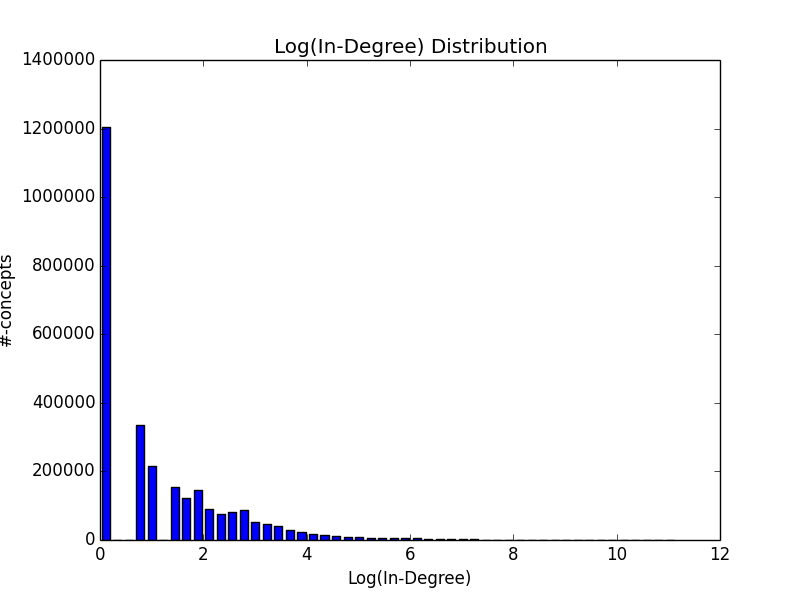
Update: 2014-03-09: I spoke about doing graph analytics in my post. One of the basic things one can do to understand a graph is to find the degree distribution. Cypher provides queries that do this, such as this one:

1
2
3
4
neo4j-sh (0)$ start n=node(*)
> match (n)-[r]->m
> return n.cui, count(r) as degree
> order by degree desc;

I tried it, but it just hung forever (I waited about 10 mins before breaking it). Not surprising, since we are trying to sort the entire database by a computed field. So I decided to dump out the degrees for all nodes using code like below and do the collecting and sorting outside Neo4j.

1
 2
 3
 4
 5
 6
 7
 8
 9
10
11
12
13
14
15
16
17
18
19
20
21
22
23
24
25
26
27
28
def degreeDistrib(inDegree: Boolean, outfile: File): Unit = {
  val writer = new PrintWriter(new FileWriter(outfile))
  val cuilist = engine.query("""
    start n=node(*) return n.cui""", 
    Map[String,Object]())
  var numProcessed = 0
  val x = cuilist.iterator().foreach(row => {
    numProcessed += 1
    if (numProcessed % 1000 == 0)
      Console.println("Processed %d nodes".format(numProcessed))
    val cui = row("n.cui")
    val larrow = if (inDegree) "<-" else "-"
    val rarrow = if (inDegree) "-" else "->"
    val countQuery = engine.query("""
      start n=node:concepts(cui={cui}) 
      match (n)%s[r]%s(m)
      return n.cui, count(r) as nrels"""
      .format(larrow, rarrow), 
      Map(("cui", cui)))
    val iter = countQuery.iterator()
    if (iter.hasNext()) {
      val crow = iter.next()
      writer.println("%s\t%s".format(crow("n.cui"), crow("nrels")))
    }
  })
  writer.close()
  writer.flush()
}

Then plot the data generated using Python and matplotlib.

1
 2
 3
 4
 5
 6
 7
 8
 9
10
11
12
13
14
15
16
17
18
19
20
import matplotlib.pyplot as plt
import numpy as np
import math

fin = open("dd_out.csv", 'rb')
xs = []
for line in fin:
  line = line.strip()
  xs.append(math.log(int(line.split()[1])))
fin.close()
hist, bins = np.histogram(xs, bins=50)
width = 0.7 * (bins[1] - bins[0])
center = (bins[:-1] + bins[1:]) / 2
fig = plt.figure()
ax = fig.add_subplot(111)
ax.set_title("Log(Out-Degree) Distribution")
ax.set_xlabel("Log(Out-Degree)")
ax.set_ylabel("#-concepts")
ax.bar(center, hist, align="center", width=width)
plt.show()


Identifying nodes with high cardinality is another way to understand a graph dataset, and we can do this as well with a few lines of Python.

1
 2
 3
 4
 5
 6
 7
 8
 9
10
11
12
from operator import itemgetter

fin = open("dd_in.csv", 'rb')
xs = []
for line in fin:
  line = line.strip()
  cui, degree = line.split("\t")
  xs.append((cui, int(degree)))
fin.close()
xss = sorted(xs, key=itemgetter(1), reverse=True)
for pair in xss[0:10]:
  print "\t".join([pair[0], str(pair[1])])

The top 10 nodes by out-degree and their corresponding out-degrees are shown below:

1
 2
 3
 4
 5
 6
 7
 8
 9
10
11
12
CUI  Out-Degree
===========================
C1442880 69031
C3160963 65817
C1261322 58469
C0677612 54725
C1123023 47823
C0728940 44444
C2628818 41235
C0021368 40720
C1964004 37755
C0000768 37044

And the top 10 nodes by in-degree:

1
 2
 3
 4
 5
 6
 7
 8
 9
10
11
12
CUI  In-Degree
===========================
C1442880 69031
C3160963 65817
C1261322 58469
C0677612 54725
C1123023 47823
C0728940 44444
C2628818 41235
C0021368 40720
C1964004 37755
C0000768 37044

We can use similar strategies to answer application level analytics type questions as well.

Saturday, January 04, 2014

Akka Content Ingestion Pipeline, Part V


The title for this post is a bit misleading, since the post is not really about Akka or Content Ingestion. This post describes a Cassandra CQL DAO for delsym, ie, a component in my content ingestion pipeline that I have been discussing under this title. The Cassandra CQL DAO is meant to be used instead of the current MongoDB layer. I chose MongoDB originally because a document-oriented database is a natural fit for a document pipeline, and I built the Cassandra CQL interface later mainly because we use Cassandra at work, and I wanted to see if a column-oriented database presented any special challenges. Plus, I wanted to learn Cassandra CQL, and this seemed a good way to learn it.

Cassandra CQL is a DSL that looks almost like SQL, so it is easy for people with an RDBMS background to learn and use. Under the covers, Cassandra stores the data in column format using various translation rules (described by John Berryman in this Youtube presentation if you are interested). This approach gives you the best of both worlds - the performance of a column database and the simplicity and convenience of a familiar user interface. SAP HANA is another database which uses a this strategy (ie, SQL interface, column storage).

Set up involves downloading and untarring to a given location, configuring and creating directories for logs, data, saved_caches and commitlog, and starting the cassandra daemon (with "cd $CASSANDRA_HOME; bin/cassandra -f"). On another terminal, we need to create the delsymdb keyspace (database in RDBMS) and the documents table. The primary key on URL is set up in the CREATE TABLE. The block below shows this being done in the CQL shell (invoked with "cd $CASSANDRA_HOME; bin/cqlsh")

1
 2
 3
 4
 5
 6
 7
 8
 9
10
11
12
13
14
15
cqlsh> create keyspace delsymdb
   ...   with replication = {'class':'SimpleStrategy', 
   ...   'replication_factor':1};
cqlsh> use delsymdb;
cqlsh:delsymdb> create table documents (
            ...   url text,
            ...   depth int,
            ...   content text,
            ...   fetchmeta map<text,text>,
            ...   fts timestamp,
            ...   text_content text,
            ...   parsemeta map<text,text>,
            ...   pts timestamp,
            ...   its timestamp,
            ...   primary key(url));

I use the Datastax Java driver to access this database from my Scala code. I followed the examples in the Instant Cassandra Query Language book, both to learn CQL (on the CQL shell) and to write the code. I also looked at the code in cassandra-samples. My DAO code is shown below, it extends the same BaseDbDao class as MongoDbDao does, so the methods are identical.

1
  2
  3
  4
  5
  6
  7
  8
  9
 10
 11
 12
 13
 14
 15
 16
 17
 18
 19
 20
 21
 22
 23
 24
 25
 26
 27
 28
 29
 30
 31
 32
 33
 34
 35
 36
 37
 38
 39
 40
 41
 42
 43
 44
 45
 46
 47
 48
 49
 50
 51
 52
 53
 54
 55
 56
 57
 58
 59
 60
 61
 62
 63
 64
 65
 66
 67
 68
 69
 70
 71
 72
 73
 74
 75
 76
 77
 78
 79
 80
 81
 82
 83
 84
 85
 86
 87
 88
 89
 90
 91
 92
 93
 94
 95
 96
 97
 98
 99
100
101
102
103
104
105
106
107
108
109
110
111
112
113
114
115
116
117
118
119
120
121
122
123
124
125
126
127
128
129
130
131
132
133
134
135
136
137
138
139
140
141
142
143
144
145
146
147
148
149
150
151
152
153
154
155
156
// Source: src/main/scala/com/mycompany/delsym/daos/CassandraDbDao.scala
package com.mycompany.delsym.daos

import java.text.SimpleDateFormat
import java.util.Date

import scala.collection.JavaConversions.asScalaBuffer
import scala.collection.JavaConversions.mapAsScalaMap
import scala.collection.mutable.ArrayBuffer

import com.datastax.driver.core.Cluster
import com.typesafe.config.ConfigFactory

class CassandraDbDao extends BaseDbDao {

  val conf = ConfigFactory.load()
  val host = conf.getString("delsym.cassandradb.host")
  val dbname = conf.getString("delsym.cassandradb.dbname")
  val tablename = conf.getString("delsym.cassandradb.collname")
  
  val cluster = Cluster.builder()
                       .addContactPoint(host)
                       .build()
  val session = cluster.connect()
  session.execute("USE %s".format(dbname))
  
  override def insertFetched(url: String, depth: Int, 
      fetchMetadata: Map[String,Any], 
      content: String): Either[FailResult,Unit] = {
    try {
      deleteByUrl(url) match {
        case Left(f) => Left(f)
        case _ => {}
      }
      val fmeta = fetchMetadata.map(kv => 
          "'%s':'%s'".format(kv._1, kv._2.toString))
        .mkString(", ")
      val insfetch = "insert into documents(" + 
        "url, depth, content, fetchmeta, fts) values (" +
        "'%s', %d, '%s', {%s}, '%s');"
        .format(url, depth, content, fmeta, iso8609(new Date()))
      session.execute(insfetch)
      Right()
    } catch {
      case e: Exception => 
        Left(FailResult("Error inserting fetch data", e))
    }
  }
  
  override def insertParsed(url: String, text: String, 
      parseMetadata: Map[String,Any]): 
      Either[FailResult,Unit] = {
    try {
      val pmeta = parseMetadata.map(kv => 
        "'%s':'%s'".format(kv._1, kv._2.toString))
        .mkString(", ")
      val insparse = "insert into documents(" +
        "url, text_content, parsemeta, pts) values (" +
        "'%s', '%s', {%s}, '%s');"
        .format(url, text, pmeta, iso8609(new Date()))
      session.execute(insparse)
      Right()
    } catch {
      case e: Exception => 
        Left(FailResult("Error inserting parse data", e))
    }
  }
  
  override def insertIndexed(url: String): 
      Either[FailResult,Unit] = {
    try {
      val insindex = "insert into documents(url, its) " +
        "values('%s', '%s')"
        .format(url, iso8609(new Date()))
      session.execute(insindex)
      Right()
    } catch {
      case e: Exception => 
        Left(FailResult("Error inserting index data", e))
    }
  }
  
  override def getByUrl(url: String, fields: List[String]):
      Either[FailResult,Map[String,Any]] = {
    try {
      val fldlist = if (fields.isEmpty) '*' 
                    else fields.mkString(",") 
      val query = "select %s from %s where url = '%s'"
        .format(fldlist, tablename, url) 
      val results = session.execute(query)
      val row = results.one()
      val colnames = if (fields.isEmpty)
        row.getColumnDefinitions()
          .asList()
          .map(coldef => coldef.getName())
          .toList
      else fields
      var colvals = ArrayBuffer[(String,Any)]()
      colnames.map(colname => colname match {
        case "url" => 
          colvals += (("url", row.getString("url")))
        case "content" => 
          colvals += (("content", row.getString("content")))
        case "depth" => 
          colvals += (("depth", row.getInt("depth")))
        case "fetchmeta" => {
          val fmeta = row.getMap("fetchmeta", 
            classOf[String], classOf[String])
          fmeta.map(kv => 
            colvals += (("f_" + kv._1, kv._2)))
        }
        case "fts" => 
          colvals += (("fts", row.getDate("fts")))
        case "text_content" => 
          colvals += (("textContent", row.getString("text_content")))
        case "parsemeta" => {
          val pmeta = row.getMap("parsemeta", 
            classOf[String], classOf[String])
          pmeta.map(kv => 
            colvals += (("p_" + kv._1, kv._2)))
        }
        case "pts" => 
          colvals += (("pts", row.getDate("pts")))
        case "its" => 
          colvals += (("its", row.getDate("its")))
        case _ => {}
      })
      Right(colvals.toMap)
    } catch {
      case e: NullPointerException => Right(Map.empty) 
      case e: Exception =>  
        Left(FailResult(e.getMessage(), e))
    }
  }
  
  override def close(): Unit = cluster.shutdown()

  def deleteByUrl(url: String): Either[FailResult,Unit] = {
    try {
      val delquery = 
        "delete from documents where url = '%s';"
        .format(url)
      session.execute(delquery)
      Right()
    } catch {
      case e: Exception => 
        Left(FailResult("Error deleting by URL: [" + 
          url + "]", e))
    }
  }
  
  def iso8609(d: Date): String = {
    lazy val sdf = new SimpleDateFormat("yyyy-MM-dd HH:mm:ss.SSS")
    sdf.format(d)
  }
}

As you can see, the code for the getByUrl() method is considerably more verbose than its MongoDB counterpart. This is because the driver does not provide a generalized method to get an object, you must specify the data type (for example, getString, getInt, etc). A better approach may have been to use ColumnDefinitions (similar to the ResultSetMetaData in regular JDBC) and maybe I will in a later iteration once I understand it better. For now, anytime we want to alter our table to add/delete columns, we will need to update this method.

Also, an additional method deleteByUrl() has to be defined. This is used by the insertFetched() method to first delete all columns for the page before new information is added in. This was not necessary in MongoDb, since the entire document would be replaced during insert. Another issue is that the metadata for fetch and parse can no longer be persisted in their native form - since the data type is map<text,text> the value must be String.

CQL also supports PreparedStatements (based on examples in cassandra-samples) but I could not get it to work - no errors were thrown, the inserts just did not happen. I ended up composing the SQL in code and then just passing it to session.execute() - the added benefit of this approach is that you can try it on the CQL shell if it doesn't work - the error messages are usually more informative. Another thing to note is that single and double quotes are not interchangeable as they are in most SQL dialects.

The test below expects a running Cassandra instance with the database and table created as described above. It runs the DAO methods and verifies the results by looking up data in the table at the end of each call.

1
 2
 3
 4
 5
 6
 7
 8
 9
10
11
12
13
14
15
16
17
18
19
20
21
22
23
24
25
26
27
28
29
30
31
32
33
34
35
36
37
38
39
40
41
42
43
44
45
46
47
48
49
50
51
52
53
54
55
56
57
58
59
60
61
62
63
64
65
66
67
68
69
70
71
72
73
74
75
76
77
78
79
80
81
82
83
84
85
86
87
88
89
90
91
92
93
94
95
96
97
98
// Source: src/test/scala/com/mycompany/delsym/daos/CassandraDbDaoTest.scala
package com.mycompany.delsym.daos

import org.scalatest.FunSuite
import org.scalatest.BeforeAndAfterAll

class CassandraDbDaoTest extends FunSuite
                         with BeforeAndAfterAll {

  val cassDao = new CassandraDbDao()
  
  override def afterAll() = cassDao.close()
  
  test("get non-existent record") {
    val url = "http://www.google.com"
    cassDao.deleteByUrl(url)
    val result = 
      cassDao.getByUrl(url, List.empty)
    result match {
      case Left(f) => fail("unexpected exception")
      case Right(r) => {
        Console.println("result=[" + r + "]")
        assert(r != null)
        assert(r.isEmpty)
      }
    }
  }
  
  test("insert after fetch") {
    val url = "http://www.google.com"
    val content = "<HTML>Some arbitary content</HTML>"
    val fetchMetadata = List(
       ("feed_title", "Some arbitary title"),
       ("feed_summary", "Jack the giant killer")).toMap
    cassDao.insertFetched(url, 0, fetchMetadata, content)
    cassDao.getByUrl(url, List.empty) match {
      case Right(row) => {
        Console.println("row (after fetch, #-cols:" + 
          row.size + ") = " + row)
        assert(row != null)
        assert(! row.isEmpty)
        assert(row.size == 9)
      }
      case Left(f) => fail("unexpected exception")
    }
  }
  
  test("insert after parse") {
    val url = "http://www.google.com"
    val textContent = "Some arbitary content"
    val parseMetadata = List(
       ("title", "The real title"),
       ("author", "Jack G Killer")).toMap
    cassDao.insertParsed(url, textContent, parseMetadata)
    cassDao.getByUrl(url, List.empty) match {
      case Right(row) => {
        Console.println("row (after parse, #-cols:" + 
          row.size + ") = " + row)
        assert(row != null)
        assert(! row.isEmpty)
        assert(row.size == 11)
      }
      case Left(f) => fail("unexpected exception")
    }
  }
  
  test("insert after index") {
    val url = "http://www.google.com"
    cassDao.insertIndexed(url)
    cassDao.getByUrl(url, List.empty) match {
      case Right(row) => {
        Console.println("row (after index, #-cols:" + 
          row.size + ") = " + row)
        assert(row != null)
        assert(! row.isEmpty)
        assert(row.size == 11)
      }
      case Left(f) => fail("unexpected exception")
    }
  }

  test("get inserted record, selected fields") {
    val url = "http://www.google.com"
    val result = cassDao.getByUrl(url, List("pts", "parsemeta"))
    result match {
      case Right(row) => {
        Console.println("partial row get = " + row)
        assert(row != null)
        assert(! row.isEmpty)
        assert(row.size == 3)
      }
      case Left(f) => {
        f.e.printStackTrace()
        fail("unexpected exception", f.e)
      }
    }
  }
}

And thats all I have for today. Hopefully next post I will talk about something else :-).